
El Paso County Criminal Records Overview
Three agencies create the bulk of El Paso County criminal records. The El Paso County Sheriff's Office runs the jail and creates the arrest and booking record. The Colorado Springs Police Department and other local agencies generate the underlying incident reports. The 4th Judicial District Attorney files the charging document, and the District Court or County Court at 270 S Tejon St holds the resulting case file. The Colorado Bureau of Investigation aggregates conviction data statewide. Each agency keeps its own files and sets its own access rules.
An arrest record and a criminal court record are not the same file. The arrest record is born at booking inside the Criminal Justice Center. The court record is born when the District Attorney files a complaint or information. The conviction record is born only if the court enters a guilty plea or verdict and a sentence. Many arrests never become convictions. Some charges are dismissed. Some are reduced. Some go through Recovery Court or DUI Court instead of a standard sentence. The records system tracks each step under a single case number once charges are filed.
Note: A complete statewide criminal history must come from the Colorado Bureau of Investigation, not from a single county arrest search or court docket result.
Arrest Records vs. Court Records in El Paso County
The first split a user has to make is the agency split. The Sheriff's Office holds the arrest record. The court holds the case file. Both can be searched, but each lives on a different portal. The Sheriff side answers who is in custody and what they were booked for. The court side answers what the prosecutor filed and what the judge did with it.
| Arrest Record | Criminal Court Record | |
|---|---|---|
| Source | El Paso County Sheriff's Office | District Court or County Court Clerk |
| Created when | Booking at the Criminal Justice Center | When the DA files a complaint or information |
| Where to find it | EPSO inmate search and records unit | Colorado Judicial Branch docket and record request |
| Contents | Booking number, charges, bond, holds, warrants | Pleadings, motions, plea, verdict, sentence |
| Public access law | CCJRA, CRS § 24-72-301 et seq. | CJD 05-01 plus court rules |
| Best for | Confirming current custody | Confirming final disposition |
For current custody data, use El Paso County inmate records. For active warrants, use warrant records. For the full court file, use court records. The Sheriff records unit handles incident reports, body-camera video, and other criminal justice records under CCJRA/CORA request rules.
How to Search El Paso County Criminal Records
A useful search starts with the right tool. The El Paso County Sheriff's inmate search covers current jail bookings. The Colorado Judicial Branch docket search covers court events. The CBI cbirecordscheck.com portal covers statewide conviction history. The PDF record request form pulls the actual documents. A user who only checks one of these will miss most of the picture.
- Open the EPSO inmate search. Enter Last Name or Booking Number to see current custody status, charges, bond, and any active warrants.
- Open the Colorado Judicial Branch docket page with El Paso County preselected. Enter the case number from the inmate record, or run a name search.
- Use the case number to identify the filing year, case class (CR for felony, M for misdemeanor, T for traffic, R for mental health), and case sequence.
- Submit the online record request form for copies of the complaint, disposition order, sentence, or register of actions.
- For a statewide criminal history, request a check at cbirecordscheck.com. Court docket data alone is not a full background check.
- For incident reports, body-camera footage, or arrest reports, contact the EPSO Records Unit at 719-520-7177.
Suppressed and juvenile cases will not return docket rows. Sealed adult cases are removed from public view but may still be confirmed through the Colorado Judicial Branch sealed case search, captured below for reference.
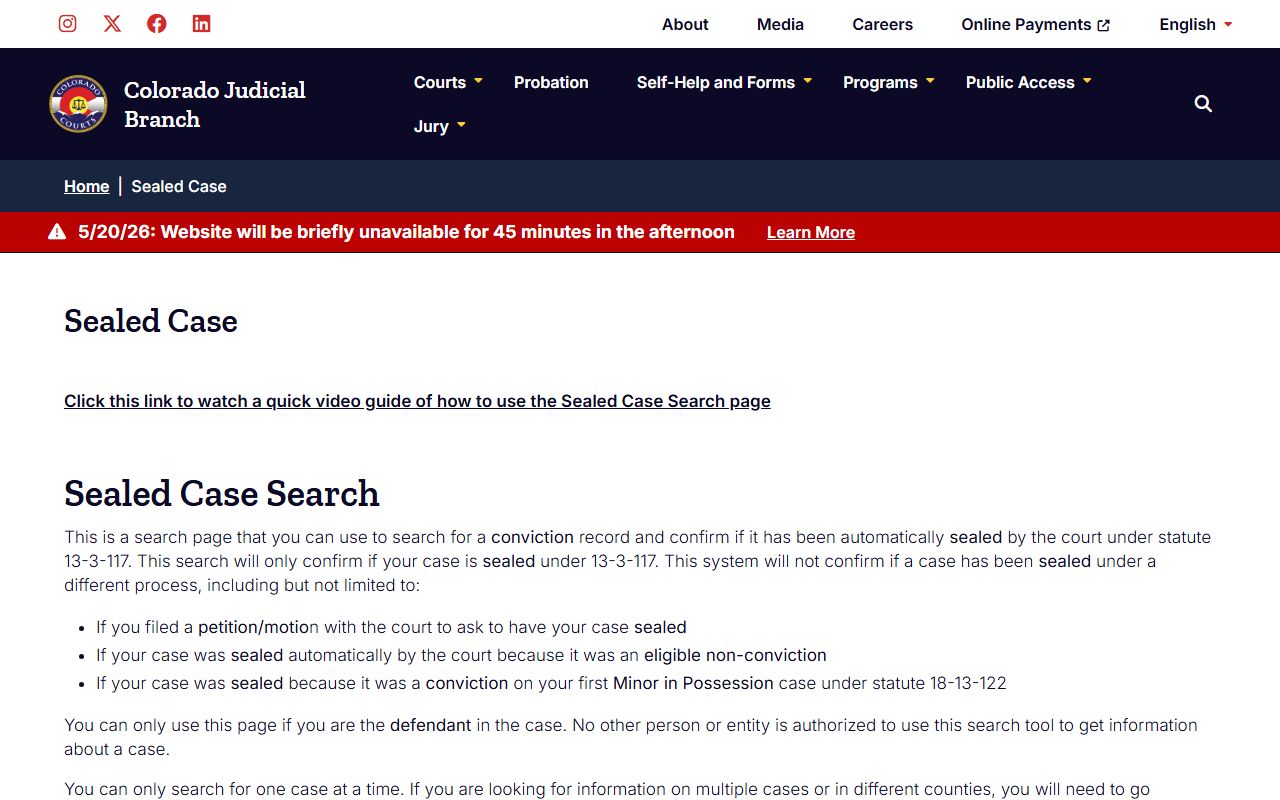
The screenshot shows the official confirmation page for automatic sealing under CRS § 13-3-117. Use it to verify whether a particular case has been sealed before assuming a record is missing or unfiled.
El Paso County Sheriff Booking Process
The booking process at the El Paso County Criminal Justice Center at 2739 East Las Vegas St generates the arrest record. The EPSO Detention Operations division runs Intake and Release under the duties set by C.R.S. § 17-26-103. Intake covers pre-admit, search, property inventory, medical screening, fingerprints, photographs, and admission to a housing ward. The booking number assigned at this stage stays with the inmate for the entire stay.
- Pre-admit processing. The arrestee is searched. Property is inventoried by Property Technicians.
- Medical and mental health screening. Pre-approved prescriptions, prescription glasses, jury-trial clothing, State ID, passports, and keys may be retained.
- Identification. Fingerprints and photographs are taken. Mug and Prints holds may apply.
- Booking. A booking number (example format 2600006440) and admin number (A-number) are assigned.
- Charge entry. Charges, bond type, bond amount, and court division are entered. Court Date and Court Case Number link to the underlying court file.
- Advisement. In-custody advisements run Monday-Friday at 1:30 p.m. via Division Video Advisement. Weekend in-custody advisement is Saturday at 5:00 p.m. Mountain Time.
- Housing placement. The inmate is placed in a CJC ward and added to the public inmate search index.
Bond is paid only at the booking desk. Under HB 21-1280 and HB 25-2510, EPSO confirms that bond fees, booking fees, and other debts never need to be paid to secure release on a money bond. The payor only needs to pay the bond amount. A $10 bond fee and a maximum 3.5% credit-card payment fee can be charged as debt after release if the payor does not pay at bonding.
Charges vs. Convictions in El Paso County
Being charged is not the same as being convicted. The 4th Judicial District Attorney files the charge. The jury or the judge enters the verdict. A plea entered in court becomes the conviction record. A dismissal or acquittal does not. The public record will show every step, so a quick read of an arrest result is often misleading. The comparison below pulls the legal standards apart.
| Charge | Conviction | |
|---|---|---|
| Stage | Filing by the prosecutor | Plea or verdict entered by the court |
| Burden of proof | Probable cause | Beyond a reasonable doubt |
| Who decides | 4th Judicial District Attorney | Judge or jury at trial; or plea agreement |
| Document filed | Complaint or Information | Disposition / Sentence Order |
| Public record | Yes, in the case file | Yes, in the case file and CBI history |
| Can it be dropped? | Yes, by dismissal | Generally no without appeal or sealing |
A deferred judgment is a special path. The defendant enters a plea, the court holds the plea, and the case is dismissed if the defendant completes terms. Deferred judgments and dismissed charges still appear on the court file but may not count as a final conviction for some purposes. The 4th Judicial District Attorney site explains charge decisions and victim services. The DA homepage screenshot below shows the office landing page.
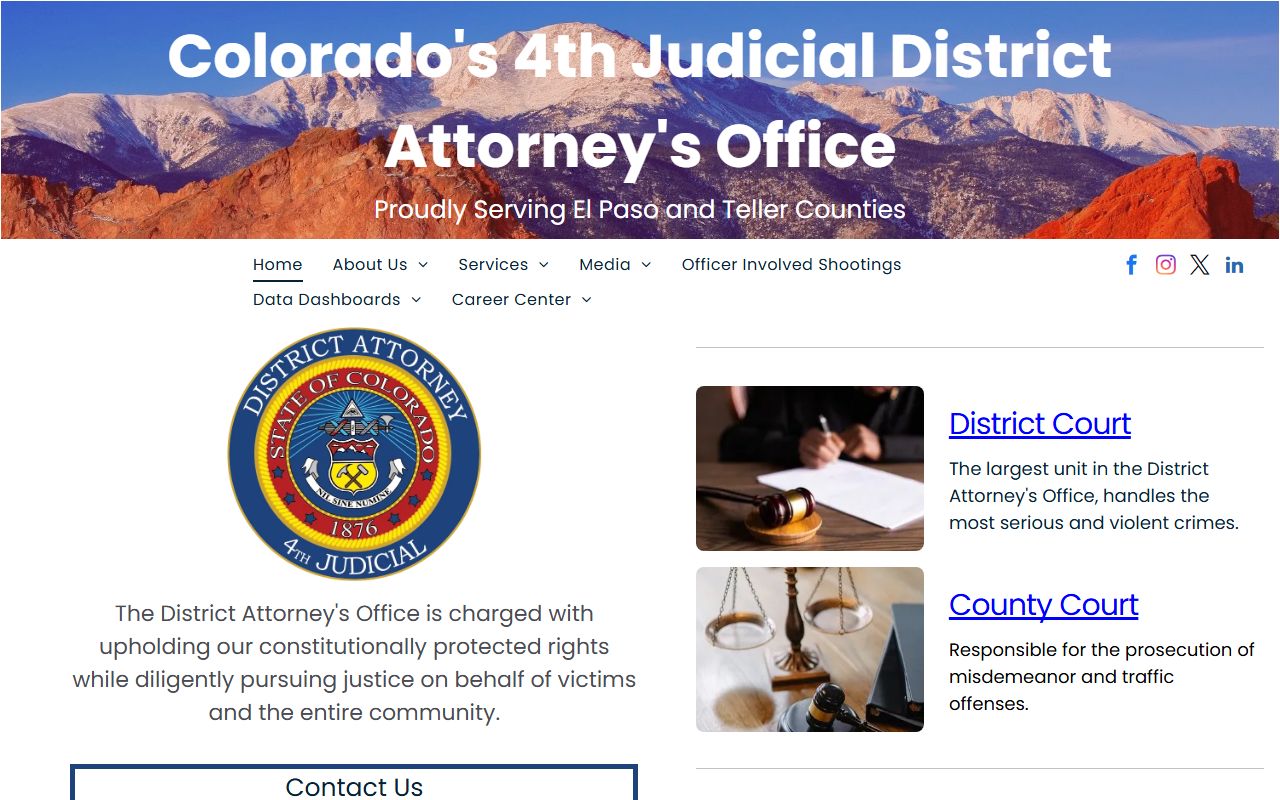
Use the DA site to find the office address, victim contact info, and current District Attorney. Appointed defense for eligible defendants comes from the Colorado State Public Defender, Colorado Springs office, not the DA.
Sealed vs. Expunged Records
Colorado treats sealing and expungement as two different remedies. Sealing applies mostly to adult cases. Expungement applies mostly to juvenile cases. Both restrict public access, but they do not work the same way. The comparison below uses the Colorado statutes that govern each path. Both also require eligibility under the statute and, in many cases, a petition or automatic-sealing notice.
| Sealed | Expunged | |
|---|---|---|
| Who it covers | Adult criminal records | Juvenile records and certain municipal juvenile cases |
| Effect | Hidden from public view; record still exists | Strong restriction or destruction |
| Law enforcement access | Limited; available to courts, police, DAs, licensing bodies | Very limited; subject to Title 19 access rules |
| Authority | C.R.S. § 13-3-117; C.R.S. §§ 24-72-703 and 24-72-706 | C.R.S. § 19-1-304 and Title 19; HB17-1204; HB19-1335 |
| How it happens | Petition, automatic for qualifying convictions | Petition; some automatic for dismissed or diverted cases |
| Common bars | Pending case, ineligible offense, waiting period | Non-qualifying offense, prosecutor or victim objection |
Common reasons a sealing or expungement petition fails include a non-qualifying offense, an insufficient waiting period, a pending case, unpaid obligations where required, an inaccurate case identification, a prosecutor or victim objection, or a statutory exception. The sealed case search confirms whether a sealing has gone through.
Public vs. Restricted El Paso County Criminal Records
Not every criminal record in El Paso County is public. Colorado layers three frameworks. CORA covers most public records. CCJRA covers law enforcement records. Chief Justice Directive 05-01 covers court files. Each one has its own exceptions. The list below covers what is generally public and what is generally limited.
- Public: adult arrest data, booking number, charge text, bond, and case file documents that are not sealed.
- Public: court docket entries for non-suppressed adult cases, including hearings and dispositions.
- Restricted: juvenile delinquency and dependency records under C.R.S. § 19-1-304 and CRS Title 19.
- Restricted: adoption records under C.R.S. § 19-5-305.
- Restricted: sealed adult convictions under C.R.S. § 13-3-117 and C.R.S. §§ 24-72-703 and 24-72-706.
- Restricted: suppressed cases on the judicial record request page (U.S. government ID required for view).
- Restricted: body-camera video and reports in open investigations under CCJRA and EPSO records policy.
- Restricted: victim identifying information under HB24-1090 and related Colorado law.
Mental health filings, protective proceedings, grand jury material, and attorney work product are also limited. The Judicial Branch Access Guide spells out the case-by-case rules. CCJRA custodian denial under C.R.S. § 24-72-305 uses a public-interest balancing test for police and sheriff records.
Note: Juvenile records are not part of the general public docket and require statutory authorization or a court order before release.
Colorado Bureau of Investigation Criminal History
The Colorado Bureau of Investigation runs the statewide criminal history check. CBI sits inside the Colorado Department of Public Safety. The CBI portal at cbirecordscheck.com is the official source for a statewide arrest-conviction record check. The Colorado Judicial Branch record request form notes that a complete statewide criminal history must come from CBI, not from the court request form. A CBI check returns Colorado-only data. For multi-state coverage, employers and others use an FBI Identity History Summary.
CBI also runs the public sex offender registry under C.R.S. § 16-22-111. Registry data appears at the CBI sex offender advanced search. The page lists names, dates of birth, offense codes, and last reported addresses for qualifying offenders. The capture below shows the official advanced search.
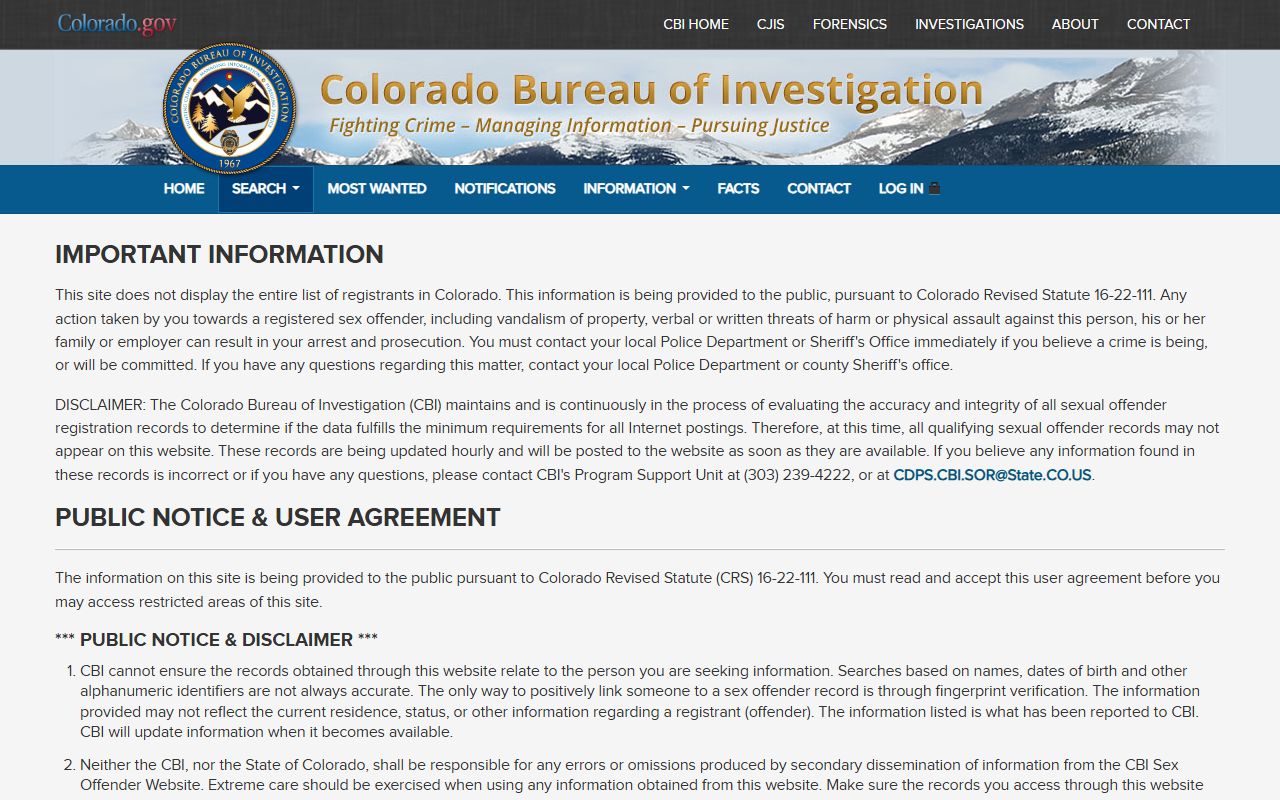
The EPSO sex offender page mirrors the CBI registry for El Paso County listings. Local agency address links and verification protocols are on the EPSO side. The state and local pages overlap, so a name found in one will appear in the other.
El Paso County Criminal Record Request Fees
Court record copy fees come from the Colorado Judicial Branch schedule. Sheriff record copy fees come from EPSO under CCJRA. The state CORA hourly rate ceiling for research and retrieval rose to $41.37 per hour effective July 1, 2024 under C.R.S. § 24-72-205(6)(b), but each agency must publish its own rate before charging it. The schedule below mirrors the live record request form and the Sheriff records page.
| Item | Fee |
|---|---|
| Court copy | $0.25 per page |
| Party or attorney copy cap on own case | $15 max |
| Certified or exemplified copy | $20 per document |
| Name search | $5 |
| Research / redaction after first hour | $30 per hour in 15-minute units |
| Off-site file retrieval | Actual cost |
| Transcript of judgment | $25 |
| Certificate of satisfaction | $20 |
| CORA hourly maximum (state ceiling) | $41.37 per hour after publication |
The court generally answers within three business days unless extenuating circumstances delay the work. Unpaid Notices of Fees expire after 14 days and the request must be resubmitted. EPSO records requests follow the timelines in C.R.S. § 24-72-203 with possible extensions for extenuating circumstances. Body-camera footage in open investigations can be withheld or redacted.
Background Check Considerations
A casual lookup is not a background check. Employers, landlords, and licensing bodies that screen people under the Fair Credit Reporting Act must use a registered consumer reporting agency. The data on a county docket or a sheriff search is real and current, but it is not packaged for FCRA use. CBI runs the official Colorado history. The FBI runs the federal Identity History Summary. For the underlying court files, the judicial record request form is the proper channel.
Important: This site is not a consumer reporting agency under the Fair Credit Reporting Act and may not be used for employment, tenant, credit, or insurance decisions.
4th Judicial District Attorney and Public Defender
The 4th Judicial District Attorney's Office serves El Paso and Teller Counties from offices in Colorado Springs. The office decides which charges to file after an arrest and represents the People of the State of Colorado at every stage of a criminal case. The DA also runs victim services, restitution, and post-conviction matters tied to El Paso County prosecutions. The DA homepage lists current leadership and contact channels.
The Colorado State Public Defender, Colorado Springs office, represents eligible El Paso County defendants. The court determines eligibility based on financial screening and case type. The Public Defender does not handle every case. Conflicts, co-defendant assignments, and certain civil-side matters route to alternate defense counsel or to private attorneys. The Colorado Springs Public Defender office lists email Springs.Pubdef@coloradodefenders.us and serves both El Paso and Teller. The statewide Public Defender line is 303-764-1400.
Federal criminal charges in El Paso County go to the U.S. District Court for the District of Colorado, with arraignments in Denver or Colorado Springs. Federal cases are searched through PACER, not the state docket. The U.S. Attorney's Office for the District of Colorado prosecutes federal cases. The Tenth Circuit handles federal appeals.
Restricted El Paso County Criminal Records
Some criminal records do not appear in any public search. Juvenile delinquency files under C.R.S. § 19-1-304 are restricted at the docket layer. Sealed adult convictions under C.R.S. § 13-3-117 are removed from public view but kept by the court. Suppressed cases on the judicial request form require a U.S. government-issued photo ID. Active grand jury material, ongoing investigations, and attorney work product are not public. Victim identifying information is protected. Mental health, capacity, and protective-proceeding details may be limited even when the underlying case is otherwise public.
Body-camera video on open EPSO investigations may be withheld or redacted under C.R.S. § 24-72-305. The Sheriff records unit reviews each request and may redact for privacy, witness safety, or investigative integrity. A denial letter must cite the statutory basis.