
Colorado Open Records Act in El Paso County
The Colorado Open Records Act is the main law for El Paso County public records. The statute sits at C.R.S. § 24-72-201 et seq. in the Colorado Revised Statutes. The law sets a rule of public access. It also lists narrow grounds where a file can be closed. The county adopts this rule in its own CORA policy. That policy points to the same statute as its base authority.
CORA covers a wide pool of files held by county and city offices in El Paso County. Think budgets, contracts, emails about county business, board agendas, permits, and other day to day government work. The Colorado General Assembly gives a plain text summary on its law summary page. The summary shows who can ask, what counts as a record, and how custodians must act.
Not every record falls under CORA. Sheriff files and other criminal justice files run on a second track called the Colorado Criminal Justice Records Act at C.R.S. § 24-72-301 et seq. Court records sit on a third track. Those follow Chief Justice Directive 05-01 and Colorado court rule, not CORA. The split matters. Sending a CORA letter to the wrong office can slow the request.
The Colorado General Assembly page also tracks the CORA fee for staff time. That cap is set by inflation under § 24-72-205(6)(b).
The state lawmakers post the fee update on a dedicated CORA hourly fee page. The page lists the current cap.
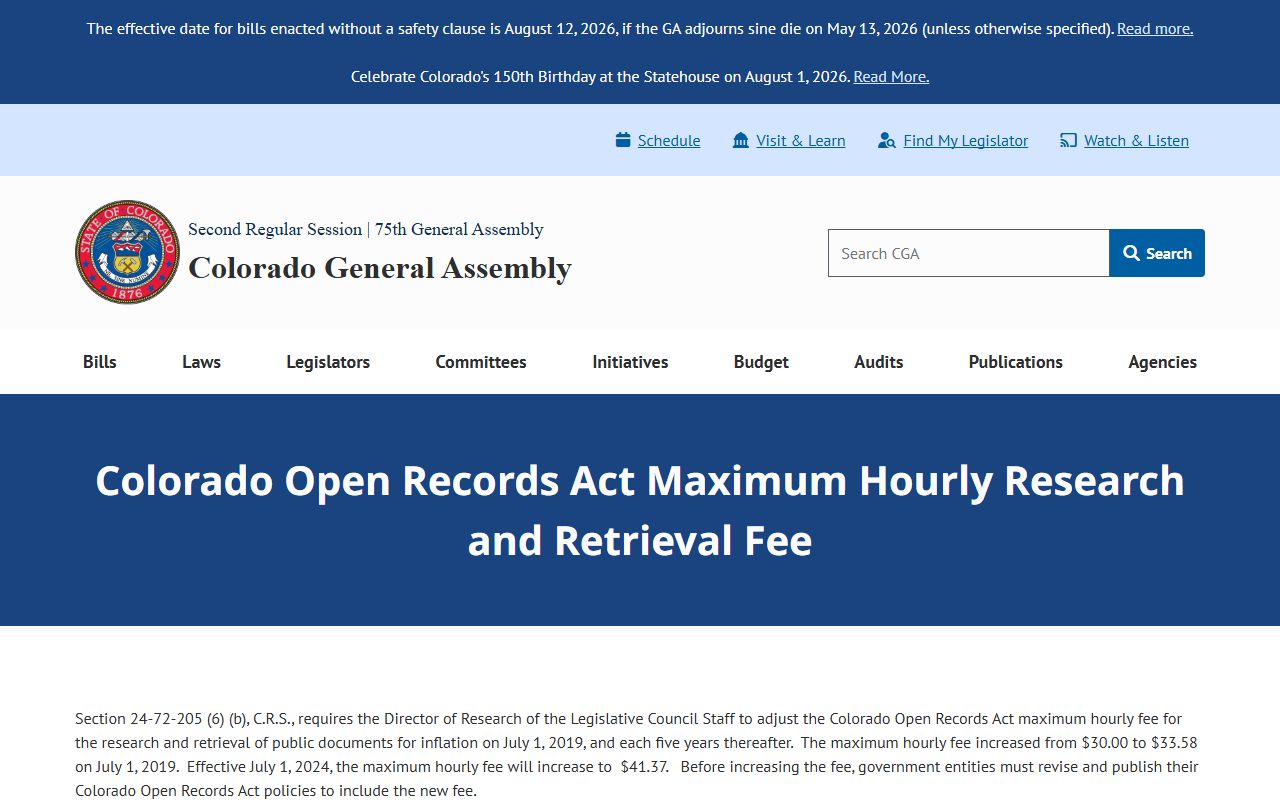
The fee notice shows the current maximum hourly rate that any custodian can charge for research and retrieval under CORA. The same limit binds El Paso County and city offices in Colorado Springs and Fountain.
CCJRA and El Paso County Sheriff Records
Sheriff reports, jail logs, body camera video, and other criminal justice records fall under the CCJRA. Sheriff Joseph Roybal runs the El Paso County Sheriff's Office. The office cites CRS § 24-72-301 et seq. as the legal base for those requests. The CCJRA gives the custodian more room to deny a request on public interest grounds than CORA does. C.R.S. § 24-72-305 sets out the denial test.
Requests for sheriff reports go through the EPSO records page. The agency uses a PowerDMS portal for online intake. Body camera files can be slow because of review and redaction. EPSO warns that video tied to an open case may stay closed until the case ends. That is normal under state access rules.
Note: Send sheriff and jail record requests to EPSO under CCJRA, not to the county Clerk and Recorder under CORA.
Court Records Are a Separate Track
Court files are not CORA files. The Colorado Judicial Branch states this on its Access Guide to Public Records. Court files follow Chief Justice Directive CJD 05-01, court rule, and case law. The Clerk of Court at the El Paso County Judicial Building handles those requests through a state form.
For copies of a divorce decree, a sentencing order, a probate file, or a register of actions, use the court form. Details on the court form, fees, and office hours live on the Clerk of Court page. The state offers an online record/document request form with case type, year, county, and document checkboxes.
The split is simple in plain words. CORA reaches the county budget. CCJRA reaches the sheriff report. CJD 05-01 reaches the court file. Match the office to the record.
What the El Paso County Clerk and Recorder Holds
The Clerk and Recorder is a non court office. Clerk Steve Schleiker is the elected official. The main office sits at 1675 W Garden of the Gods Rd, Suite 2201, Colorado Springs, CO 80907. The main phone is 719-520-6202. Hours run Monday through Friday from 8:00 a.m. to 4:30 p.m. The office is closed on legal holidays. The Clerk and Recorder homepage lists four departments: Recording, Elections, Motor Vehicle, and Clerk to the Board.
The Recording Department holds the bulk of public records that locals look up. Deeds, deeds of trust, liens, plats, marriage and civil union licenses, and DD-214 military files are kept here. The Recording Department page lists the phone at 719-520-6200 and the email at recweb@elpasoco.com. Copy requests go to 719-520-6198 or copyrequests@elpasoco.com.
- Real estate deeds, mortgages, releases, and plats
- Liens, UCC filings, and federal tax filings
- Marriage and civil union licenses (apply on the Marriage and Divorce Records page)
- DD-214 military discharge filings
- Voter registration files held by the Elections Department
- Board of County Commissioners meeting records
Land records and marriage files are open to the public through the Aumentum Recorder portal. The portal at publicrecordsearch.elpasoco.com lets users run a quick search by name or by date range.
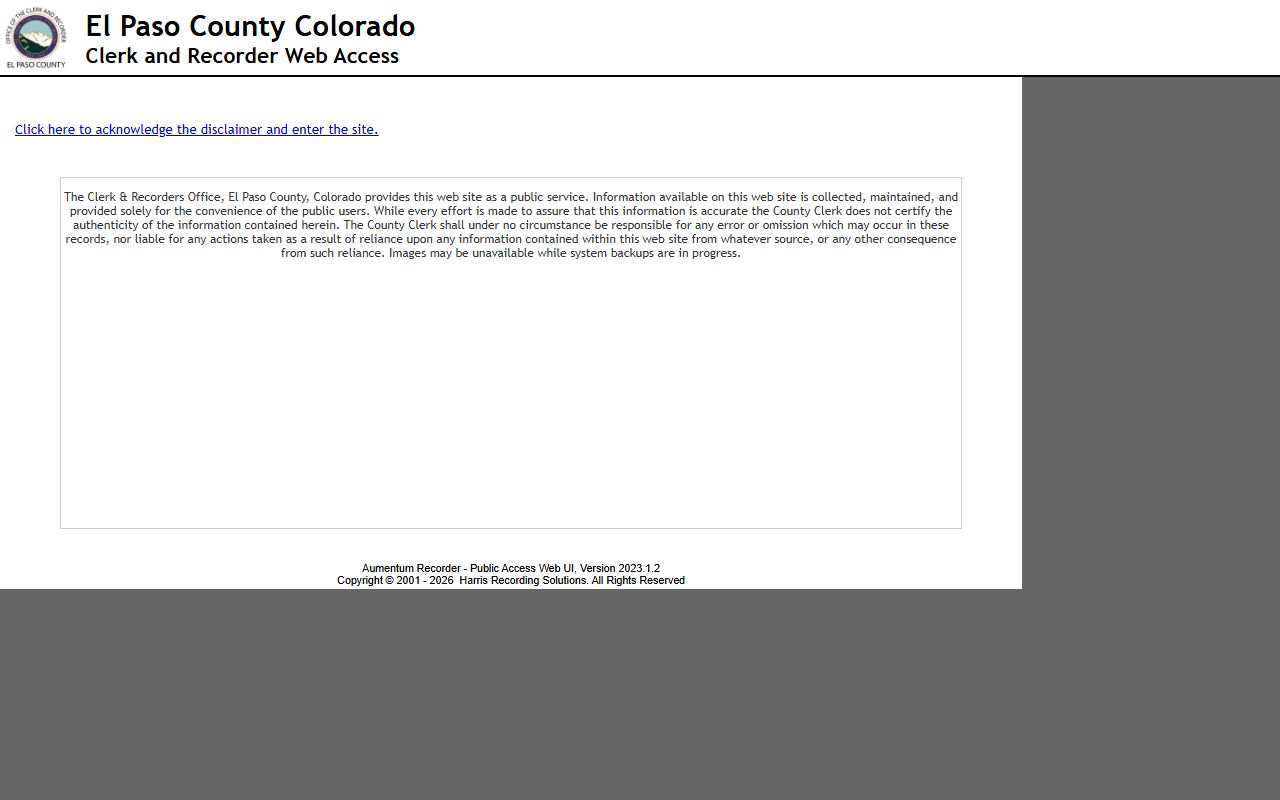
The portal shows the public search entry and the optional login window. Most users do not need an account to view land and marriage data.
How to File an El Paso County Public Records Request
A CORA letter does not need a special form in most cases. The county will accept a clear written request by email or by mail. The point is to name the file and name the office that holds it. A vague request will slow the search. A clear one will speed it up.
- Pick the right office. Use the Clerk and Recorder for deeds, marriage, and county admin files. Use EPSO for sheriff or jail files. Use the Clerk of Court for court files.
- Describe the record. Give names, dates, addresses, case numbers, or a date range. Tight detail cuts staff time and the fee that comes with it.
- Send the request. Use email, the office web form, U.S. mail, or walk in. The Clerk and Recorder takes copy requests at copyrequests@elpasoco.com. EPSO uses a PowerDMS link on its records and video request page.
- Wait for the response. CORA sets a three working day standard under § 24-72-203. The custodian can extend by up to seven more working days for extenuating circumstances.
- Pay the fee. The office sends a notice of fees with a total cost. Pay by check, card, or cash by office rule. The records ship after payment clears.
- Review the file. Some content can be redacted under § 24-72-204. Ask the custodian for the reason in writing if a denial is unclear.
El Paso County Public Records Request Form Fields
The county CORA policy and the office intake forms ask for a short set of facts. The table below shows the common fields a requester should plan to include even when writing a free form letter or email.
| Field | Required | Notes |
|---|---|---|
| Requester Name | Yes | Full legal name; CORA does not bar requests by purpose. |
| Mailing Address | Yes | Used for the notice of fees and mailed copies. |
| Phone Number | Yes | For staff to clarify the scope of the request. |
| Email Address | Yes | Most fee notices come by email. |
| Description of Records | Yes | Names, addresses, case or instrument numbers, file type. |
| Date Range | No | Tight range cuts research time and fees. |
| Format Preference | No | Paper, email, or pickup; certified copies cost more. |
| Pickup or Mail | No | Pickup saves mail handling fees. |
The county will reach out if a field is missing or unclear. A complete request gets a faster fee notice and a faster turnaround. Send the request to the office that holds the record, not to a general inbox.
El Paso County Public Records Response Time
CORA sets a default of three working days for the custodian to make the file available. The deadline starts when the office gets the request. If a request is broad or the file is offsite, the custodian can extend the deadline by up to seven more working days. The county must state the reason for the extension in writing. That rule comes from § 24-72-203.
CCJRA does not use the same hard clock as CORA. EPSO often gives a longer estimate for body camera files because of review and redaction. Sheriff records can also need a public interest balance under § 24-72-305. Court record requests follow the Judicial Branch standard of three business days unless extenuating circumstances apply.
Note: Mark requests urgent only when truly urgent. A real deadline tied to a court date or a closing helps the office prioritize.
El Paso County Public Records Fees
Copy fees in Colorado follow a state ceiling. The General Assembly sets the staff time cap at $41.37 per hour under § 24-72-205(6)(b). That cap took effect on July 1, 2024. Each agency must publish a fee policy before charging the cap. Some local offices still list lower rates on older pages. Always confirm the rate in the fee notice before paying.
| Item | Amount |
|---|---|
| Standard paper copy, per page | $0.25 |
| Research and retrieval, hourly cap (state) | $41.37 (first hour often free) |
| Certified marriage license copy | $1.00 per document |
| Plain marriage license copy | $0.25 per license plus $0.25 per application |
| EPSO report review and redaction, up to 10 pages | $8.00 |
| EPSO report review and redaction, 11+ pages | $8.00 plus $0.25 per extra page |
| Mail handling, 1-10 pages | $1.25 |
| Mail handling, 11-20 pages | $2.00 |
| Mail handling, over 20 pages | $2.50 |
The first hour of research is often free under CORA practice. Fee waivers can be granted when the records serve a clear public interest. The custodian decides waiver requests on a case by case basis. Send a short note with the request if a waiver is needed.
Note: The Sheriff's office may still display $32.00 per hour on older pages, but the state cap is the new ceiling.
El Paso County Clerk and Recorder Contact
For CORA requests aimed at recorded land files, marriage licenses, or other documents kept by the recording office, use the contact card below. The Clerk and Recorder is a separate elected office and does not hold court files.
El Paso County Clerk and Recorder
Clerk: Steve Schleiker
1675 W Garden of the Gods Rd, Suite 2201
Colorado Springs, CO 80907
719-520-6202
steveschleiker@elpasoco.com
Monday-Friday 8:00 a.m.-4:30 p.m.
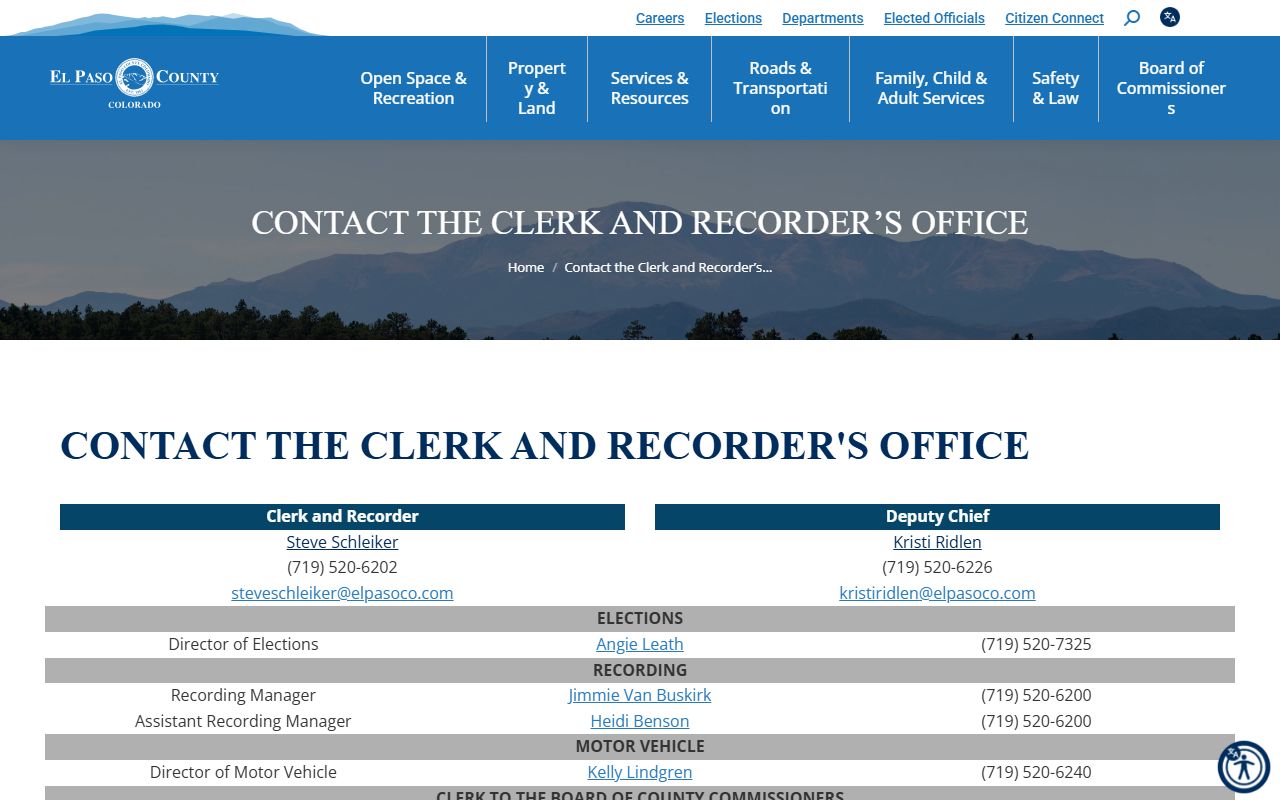
The contact page lists each department manager. It also points CORA requests to the right team based on the record type.
Records That Are Exempt From CORA
CORA lists narrow grounds for denial at § 24-72-204. The grounds protect medical and personal data, security and infrastructure plans, draft documents, work product, ongoing investigations, and other sensitive content. Juvenile files are protected under C.R.S. § 19-1-304. Adoption files are protected under § 19-5-305.
Body camera footage on an open case is often withheld or redacted. Victim identifying details may be withheld under HB24-1090 and related Colorado law. Social Security numbers and bank account data are redacted from public copies. Records that are sealed by court order are not produced.
The General Assembly publishes the full statute on its law page. Read the section before assuming a record is closed.
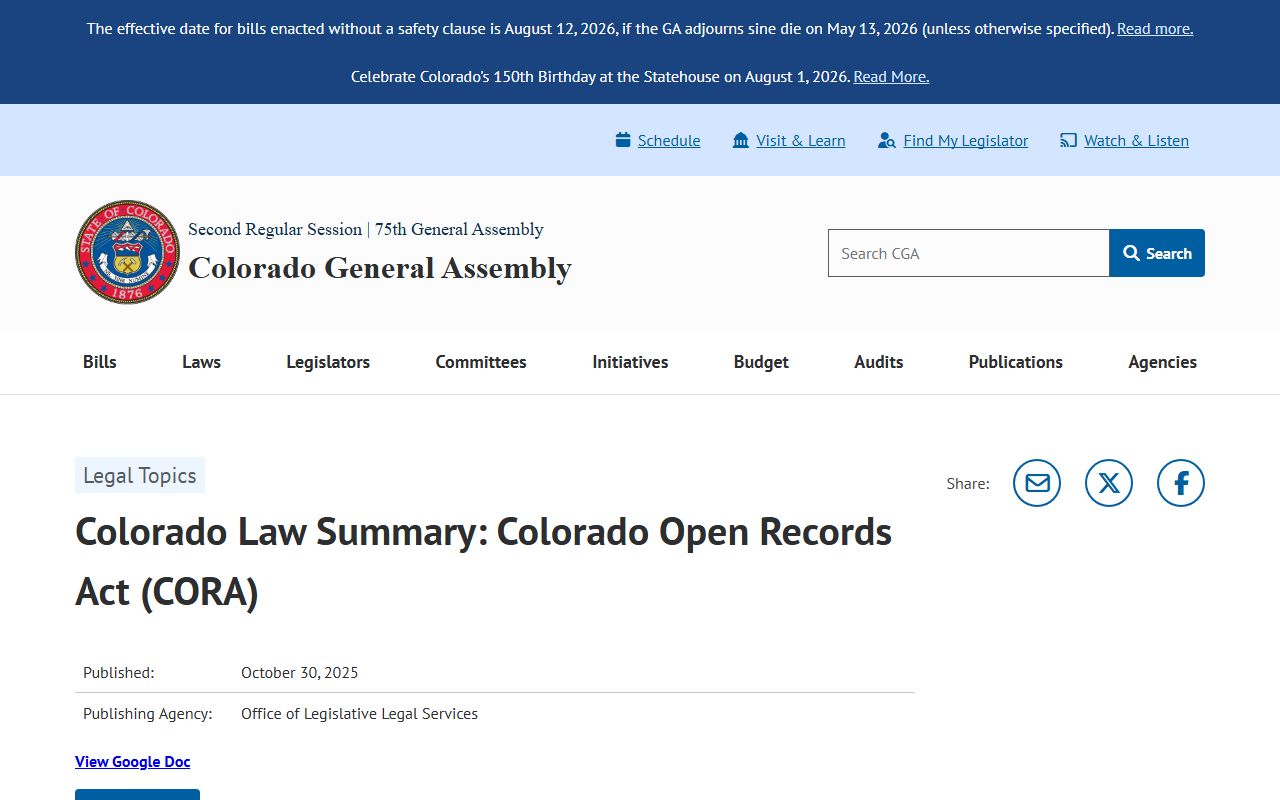
The page gives a plain text view of the statute and any recent amendments. It is the safest starting point when an office cites a denial.
If a Public Records Request Is Denied
The first step is to ask for the denial in writing. CORA gives the requester the right to a written reason. The reason should cite the statute or court order that supports the denial. A clear written reason can fix a misread of scope or office.
The next step is a meet and confer. The county CORA policy spells out an internal review process. Many cases get fixed at this step because the request can be narrowed or the file can be redacted in part. Skip ahead to court only when the office will not budge.
If the agency still refuses, the requester can sue in district court under CORA. The court can order the file released and can award costs and fees. The 4th Judicial District handles those suits for El Paso County matters. See the District Court page for filing details.
Online Portals for El Paso County Public Records
Some files do not need a CORA letter. Recorded documents and marriage records are open through the Aumentum Recorder portal at publicrecordsearch.elpasoco.com. Users can search by grantor and grantee, by date range, by document type, or by reception number. The portal also serves marriage and civil union license records.
For court events and case status, use the free El Paso County docket search. For court documents, use the state record request form on the Judicial Branch site. The sheriff hosts a public inmate search tool for jail roster lookups.