
What Probate Covers in El Paso County
Probate is the court process that handles a person's estate after death. It also covers protective cases for living adults and minors who can't manage their own affairs. In El Paso County, every probate case is a District Court case. The state has only one standalone probate court, and that court sits in Denver. The Denver Probate Court is the only probate court of its kind in Colorado. Every other county routes probate to the District Court bench. The El Paso County District Court runs a Probate Division to handle the workload, but it is not a separate court.
The cases fall into a few buckets. Estate cases open after a death, with or without a will. Protective proceedings open during a person's life when a guardian or conservator is needed. Trust cases can also land in the Probate Division when a trust is challenged or supervised. Some mental health commitments and elder-abuse protective orders flow through the same docket. The official El Paso County court landing page lists the probate walk-up hours. Protective Proceedings open every Wednesday morning. Estate Cases open every Wednesday afternoon.
Note: El Paso County has no separate probate court. Probate is the District Court Probate Division.
El Paso County Probate Terms Defined
Probate uses words that don't show up in daily life. A short glossary helps before reading any filing. Each term below comes straight from Colorado probate practice. Most are defined under CRS Title 15. The court uses them on every order and form.
- Testator
- The person who signed the will. A female testator is sometimes called a testatrix.
- Executor
- The person named in the will to settle the estate. Colorado uses the broader term "personal representative" on most court forms.
- Administrator
- The personal representative when there is no will, or when the will doesn't name one.
- Intestate
- Dying without a valid will. The estate passes by Colorado's intestate succession rules.
- Guardianship
- A court order that gives one person the right to make personal and health choices for a minor or incapacitated adult.
- Conservatorship
- A court order that gives one person the right to manage the money and property of a minor or incapacitated adult.
- Fiduciary
- Any person, like a personal representative, guardian, or conservator, who is trusted by the court to act for someone else's interest.
- Letters testamentary
- The court paper that proves the personal representative is in charge. Banks, the DMV, and title companies all ask for letters.
- Beneficiary
- A person or charity who is set to receive money or property from the estate or a trust.
Letters of administration and letters of guardianship work the same way for those case types. Each letter is a court paper that proves the holder has the right to act for the estate or the protected person.
How to Search El Paso County Probate Records
Probate case files sit with the Combined Court Clerk at the El Paso County Judicial Building. Some basic case data shows on the Colorado Judicial Branch El Paso County docket search. Full case documents do not. To get a copy of a will, letters, an inventory, or any other probate document, file a record request with the court. The Colorado Judicial Branch hosts an online record request flow. The El Paso Combined Court also takes paper requests by mail.
- Open the Colorado Judicial Branch Record/Document Request Form. Pick Case Type Probate. Pick El Paso County. Add the case number if known.
- Enter party names. Use the decedent's name for estate cases. Use the protected person's name for guardianship or conservatorship cases. Filing year can be picked from the dropdown.
- Check the document boxes that match the request. Options include Letters, Will, Trust, Application, Petition, Closing, Claims, and Date of Death.
- Add a copy of a government-issued ID. Submit the form.
- Wait for the Notice of Fees. Pay through the link in the notice. Copies are sent by mail or email after payment clears.
- For a walk-in pull, visit the Probate Division at 270 S Tejon St on a Wednesday during posted hours. Protective Proceedings open 8:30 a.m.-11:30 a.m. Estate Cases open 1:00 p.m.-4:00 p.m.
Below is a screenshot of the official El Paso County landing page where the probate hours and quick links live.
The Colorado Judicial Branch El Paso County page is the entry point for every probate question.
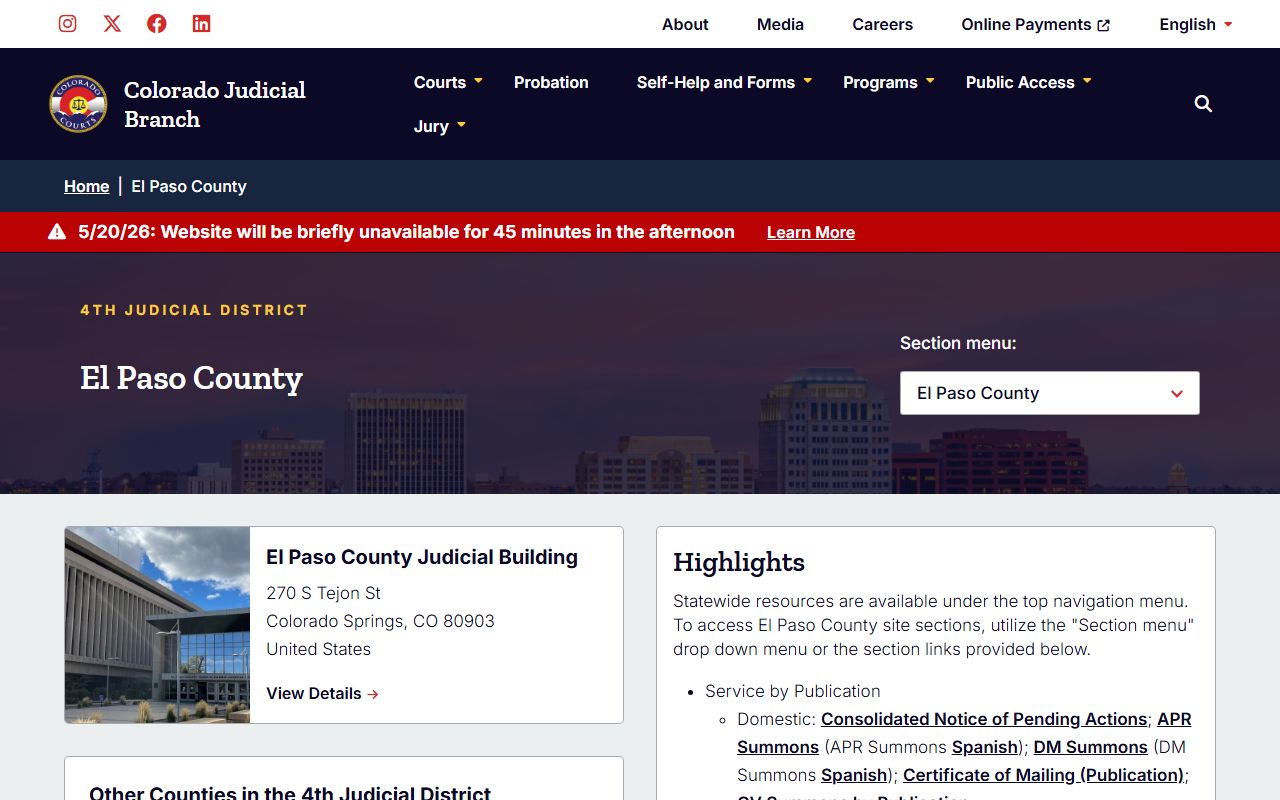
The page lists the courthouse address, the main phone, the docket search, the record request form, and the weekly probate walk-up windows.
El Paso County Probate Search Fields
The online record request form asks for the same fields whether the case is an estate, a guardianship, or a trust dispute. The form is the single best way to search El Paso County probate records by name or filing year. The fields below come straight from that form.
| Field / Document | Type | Required | Notes |
|---|---|---|---|
| Case Type Probate | dropdown | Recommended | Filters the search to probate filings. |
| Year case was filed | dropdown | Optional | Selectable from 2026 back to 1873. |
| County / location | dropdown | Yes | Pick El Paso County. |
| Party Information | text | Yes | Decedent, protected person, petitioner, or fiduciary name. |
| Date of Death | checkbox / text | Optional | Used to confirm estate match. |
| Letters | checkbox | Optional | Testamentary, administration, guardianship, or conservatorship. |
| Will | checkbox | Optional | Filed will copy. |
| Trust | checkbox | Optional | Trust document if in case file. |
| Application / Petition | checkbox | Optional | Opening pleadings. |
| Closing | checkbox | Optional | Closing documents. |
| Claims | checkbox | Optional | Creditor claims. |
Note: A case number speeds up the search. Without one, the requestor should add as much identifying data as possible.
El Paso County Probate Division Contact
The Probate Division sits inside the El Paso County Judicial Building. There is one contact card. The District Court Probate Division is the only probate office in the county.
District Court Probate Division
El Paso County Judicial Building
270 S Tejon St
Colorado Springs, CO 80903
719-452-5000
Walk-up Wednesdays only:
Protective Proceedings 8:30 a.m.-11:30 a.m.
Estate Cases 1:00 p.m.-4:00 p.m.
The Probate Division shares the main phone line with the rest of the El Paso County Combined Court. Probate filings can also be made through the e-file portal used for civil cases. The official building location page lists parking and security rules.
How to Open an El Paso County Probate Case
Opening a probate case is a paper-heavy job. The personal representative or the petitioner must file the right opening pleadings. Most filings are now done online through the Colorado Courts E-Filing site. Self-represented filers can use the Self-Help center forms. The Colorado Judicial Branch keeps a full library of probate forms by case type.
- Pick the right case type. Estate cases use forms in the JDF 900 series. Adult guardianship and conservatorship use the JDF 800 series. Minor cases use the JDF 700 series.
- File the application or the petition with the El Paso County Combined Court. Pay the filing fee. The fee depends on case type and the size of the estate.
- Serve interested persons. Heirs, devisees, and creditors get notice under Colorado probate rules.
- Attend the first hearing if the case is contested or if it falls under formal probate. Informal estates may not need a hearing at all.
- Pick up letters at the Clerk's counter, or download from the e-file site, once the court signs the order.
- File the inventory, the accountings, and the closing papers on the schedule the court sets. The case stays open until the closing order issues.
Small estates may not need a full case. Colorado law allows a small-estate affidavit when the estate value sits under the statutory cap and the estate has no real property. The affidavit is filed with the holder of the asset, not the court.
El Paso County Probate Filing and Copy Fees
Probate filing fees are set by the Colorado Judicial Branch under CJD 06-01. They are the same in every county. Copy and certification fees flow through the same record request form used for other case copies. The table below shows the copy fees and the most common case-related charges.
| Item | Amount |
|---|---|
| Plain copy, per page | $0.25 |
| Certified or exemplified copy | $20 per document |
| Name search | $5 |
| Research / redaction after first hour | $30 per hour |
| Off-site retrieval | Actual cost |
| Letters testamentary or administration | Set on the Notice of Fees |
| Guardianship or conservatorship filing | Set by CJD 06-01 |
The court sends a Notice of Fees after the record request comes in. Pay through the link in the notice. The court will not pull copies until the fee clears. Walk-in copy work is paid at the counter by card or cash. The Access Guide to Public Records covers the fee structure for every Colorado court.
What El Paso County Probate Records Show
A probate case file holds the paper trail of an estate or a protective case. The contents depend on the case type. Estate cases hold a will if one was filed, the application or petition for probate, the order admitting the will, letters, the inventory of estate assets, accountings, claims by creditors, distribution receipts, and the closing order. Protective cases hold the petition, professional evaluations, court visitor reports, letters of guardianship or conservatorship, annual reports, and any orders setting the powers of the fiduciary.
Some files include trust paperwork if a trust is being administered or contested. Trust documents that were never filed with the court do not show up. The court only holds the documents that were filed in the case. The Colorado Judicial Branch Access Guide to Public Records shows which document types are presumed open and which need an additional showing before release.
Note: Probate records are case files held by the District Court, not the Clerk & Recorder.
Restricted El Paso County Probate Records
Not every probate paper is public. Protective proceedings have tighter rules than estate cases. Court visitor reports, medical or capacity evaluations, and financial account numbers are often shielded. Minor guardianship and minor conservatorship files have extra protections. Mental health commitment records under Title 27 are confidential by default. Adoption records that touch probate are sealed under Colorado law. Some sealed estate files exist when the court has signed a sealing order in a narrow case.
Requestors who hit a restricted record can sometimes still get a redacted copy. Ask the Clerk what is releasable. A motion to unseal can be filed by an interested person if the case-specific rules allow. The Chief Justice Directive 05-01 sets the framework for court record access in Colorado.